Source-backed desk research · September 2026

The 7 cheapest AI APIs that are actually practical

Token price is only the start. We compared the low-cost providers on workload fit, migration friction, pricing clarity, and the cost of getting a usable result.

No card for the Omev trial · Prices checked September 11, 2026 · Always verify before deploying

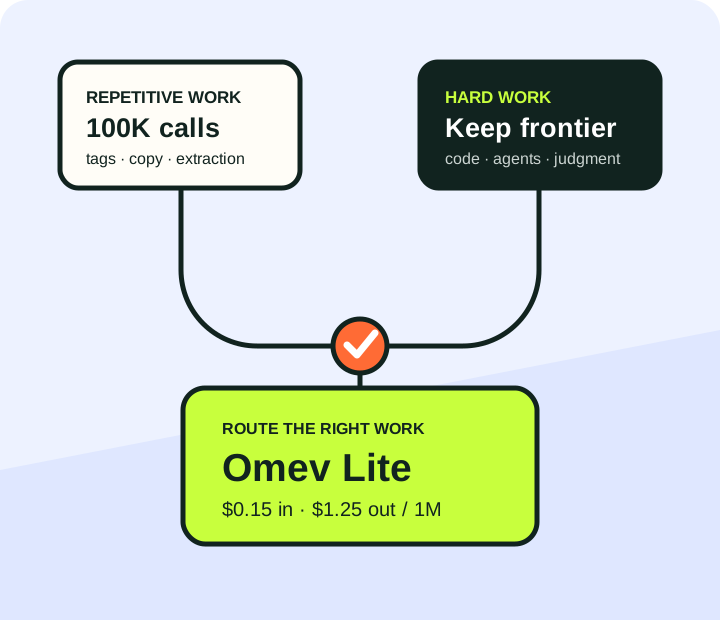
Diagram showing repetitive AI jobs routed to Omev Lite while difficult work stays on frontier models
7 providersShortlisted for real use
Official ratesLinked to source pages
5 criteriaBeyond sticker price
1 clear winnerOmev for repeatable work

How we ranked them

Cheap means cost per useful task

A tiny token rate is attractive, but it is not enough. Our ranking favors providers that can lower a production bill without turning integration, output cleanup, or billing into a second job.

30%Practical unit economics
25%Repeatable workload fit
20%Migration and API fit
15%Pricing transparency
10%Catalog and flexibility

Scope: Prices below are illustrative published rates, not like-for-like model benchmarks. Model quality, context, throughput, caching, and data policy differ. We did not send a standardized prompt suite to every provider.

At a glance

Cheapest AI APIs compared

Start with the workload, then inspect the rate. “Example rate” names the model or pricing rule so you can avoid comparing unlike products as if they were equivalent.

Provider comparison, September 2026
RankProviderBest forExample published rateFree accessAPI fit
1 Omev AI iconOmev AI
Top pick
Repeatable, structured production work Lite: $0.15 in / $1.25 out $5 credit, 10 days OpenAI-compatible
2DeepInfra iconDeepInfraLow-cost open-model catalogLlama 3.3 70B: $0.10 / $0.32Check current offerOpenAI-compatible
3OpenRouter iconOpenRouterOne key across many providersProvider rate + 5.5% platform fee25+ free modelsOpenAI-compatible
4Together AI iconTogether AIServerless to dedicated pathQwen 3.5 9B: $0.10 / $0.15No trial; $5 minimum creditOpenAI-compatible
5Fireworks AI iconFireworks AIFast serving and fine-tuningGPT-OSS 20B: $0.07 / $0.30$1 creditOpenAI-compatible
6GroqCloud iconGroqCloudVery high token throughputGPT-OSS 20B: $0.075 / $0.30Free tierOpenAI-compatible
7Google Gemini iconGemini APIFree prototyping and Google stack3.7 Flash: $0.75 / $3.75*Free tierGoogle SDK / REST

Rates are USD per 1M input/output tokens unless noted. *Gemini 3.7 Flash introductory paid rate through December 31, 2026. Taxes, caching, batch discounts, tool calls, and enterprise terms excluded.

Workload matrix

Pick by job, not logo

A multi-provider stack is often cheaper and safer than forcing every request through one model.

Best provider by workload
WorkloadBest pickWhyWatch for
Product copy, metadata, taggingOmev AIPurpose-fit Lite tier and OpenAI-compatible integrationCustomer content may be used for training
Broad open-model experimentationDeepInfraLarge catalog and low entry ratesPerformance varies by model
Provider routing and fallbacksOpenRouter500+ models and 80+ providersPlatform funding fee
Fine-tuned model lifecycleFireworks AITraining plus serverless and dedicated servingMore deployment choices to evaluate
Latency-sensitive chatGroqCloudPublished throughput around 1,000 t/s on GPT-OSS 20BSmaller production catalog
Multimodal prototype on a free tierGemini APIFree AI Studio access and strong multimodal toolingFree-tier data terms and quotas differ

The ranking

Our 7 low-cost API picks

Each provider earns its place for a specific reason. The caveats matter as much as the headline rate.

9.3 / 10

Best for production teams moving repetitive, well-specified work off expensive general-purpose models.

$0.15Lite input / 1M tokens
$1.25Lite output / 1M tokens

Omev AI

Omev wins our overall ranking because its product is built around the boring volume that quietly inflates AI bills: classification, structured extraction, translation, catalog copy, metadata, summarization, and bulk rewriting. Instead of offering hundreds of models, it offers two of its own and asks you to route one suitable job at a time.

  • OpenAI-compatible base URL and familiar chat-completions shape
  • $5 free credit for 10 days, with no card required
  • Published Lite and Pro rates; no monthly or seat fee
  • Image generation from $0.0192 per successful 1K image
The caveat: Omev says customer inputs and outputs are used to train and improve its models with no opt-out, and it does not currently claim SOC 2, ISO 27001, or a contractual SLA. Keep sensitive or regulated workloads elsewhere.
Test your workload on Omev →

Check Omev's live rate card

DeepInfra icon02

DeepInfra

DeepInfra is the strongest pick when your priority is a wide open-model catalog with an extremely low pricing floor. Its published list includes Llama 3.3 70B Instruct Turbo at $0.10 input and $0.32 output, while smaller legacy models can cost much less.

Best for: teams comfortable benchmarking open models and choosing the best price-quality point themselves.

See DeepInfra pricing ↗
OpenRouter icon03

OpenRouter

OpenRouter is the pragmatic answer when “cheap” means shopping across providers, setting routing preferences, and failing over without integrating every vendor separately. Its current pricing page lists 500+ models and 80+ providers.

Best for: broad model choice, routing rules, fallbacks, and centralized spend controls.

See OpenRouter pricing ↗
Together AI icon04

Together AI

Together covers the full open-model path: serverless inference for variable traffic, batch discounts, fine-tuning, and dedicated endpoints for steadier loads. The same inference API works across serverless and dedicated deployments.

Best for: teams that expect to graduate from pay-per-token experiments to reserved serving capacity.

See Together serverless rates ↗
Fireworks AI icon05

Fireworks AI

Fireworks combines serverless inference, managed fine-tuning, and on-demand GPU deployments. That makes it attractive when a cheap experiment may become a customized, latency-sensitive production model later.

Best for: AI-native teams that want to tune, serve, and scale open models in one platform.

See Fireworks serverless rates ↗
GroqCloud icon06

GroqCloud

Groq is the speed-first option in this list. Its model page publishes roughly 1,000 tokens per second for GPT-OSS 20B at a still-low token rate, which can matter more than saving a few cents when the user is waiting.

Best for: interactive chat, voice loops, and latency-sensitive open-model inference.

See Groq models and rates ↗
Google Gemini icon07

Google Gemini API

Gemini belongs on a low-cost shortlist because Google AI Studio offers free usage in supported regions and the platform has strong multimodal tooling. The paid rate is not always the lowest, but the free path makes prototyping accessible.

Best for: multimodal prototypes, very long context, and teams already using Google Cloud.

See Gemini API pricing ↗

Cost calculator

Price your monthly token shape

This rough calculator shows why input/output mix matters. It uses one published example model per provider and excludes caching, retries, tool calls, batch discounts, and taxes.

Your workload

Use an average request. Check actual token usage in your current provider before acting on the estimate.

Estimated token bill

DeepInfra · Llama 3.3 70B$0.00
Fireworks · GPT-OSS 20B$0.00
Groq · GPT-OSS 20B$0.00

This is arithmetic, not a quality comparison. The example models have different capabilities. A provider with a lower estimate may still need more retries or a different model to meet your quality bar.

Decision table

What matters after price

Use these four checks before you move a meaningful share of production traffic.

Production decision checklist
CriterionQuestion to askGood evidenceRed flag
Output qualityDoes it pass on your real prompts?Blind review across 20–50 examplesOne polished demo
True task costHow many retries and repairs?Cost per accepted resultToken price alone
Data fitCan this provider process the payload?Policy and DPA match the dataAssuming “API” means private
ReliabilityWhat happens on timeout or failure?Measured fallback and rollbackNo provider escape hatch

Routing playbook

Move one job, not your whole stack

A controlled routing test makes price, quality, and rollback measurable before the procurement conversation gets large.

1

Find the volume

Choose a repeated job with a stable prompt and clear output shape.

2

Build a small eval

Use 20–50 representative requests and define pass/fail before testing.

3

Route 5–10%

Measure accepted outputs, retries, latency, and cost per completed task.

4

Keep a fallback

Retain your current provider path until the cheaper route is dependable.

FAQ

Questions before you switch

Short answers to the questions that usually matter more than the headline rate.

What is the cheapest AI API?

There is no single cheapest API for every workload. DeepInfra and some aggregators expose very low per-token catalog floors, while Omev AI is our top overall pick for repeatable production tasks because it combines low published rates with task-focused models and an OpenAI-compatible interface.

Why is Omev AI ranked first?

Omev AI ranks first for teams routing repetitive, structured work away from expensive frontier models. Its Lite rate is $0.15 per million input tokens and $1.25 per million output tokens, it offers a $5 no-card trial, and it uses an OpenAI-compatible API. It is not the right choice for sensitive data or every reasoning-heavy task.

Should I pick the API with the lowest token price?

Not automatically. Compare the cost of a usable result, including retries, validation, latency, model quality, and engineering time. A cheaper token can become an expensive task if the output needs repeated cleanup.

Can I use more than one AI API provider?

Yes. A practical setup keeps frontier models for difficult reasoning and routes structured, high-volume tasks to a lower-cost provider. Add evaluations, spend limits, and a fallback before moving meaningful traffic.

Are OpenAI-compatible APIs drop-in replacements?

They reduce integration work, but “compatible” does not mean identical. Model names, parameters, tool behavior, rate limits, error responses, and structured-output support can differ. Read the provider docs and test your exact request shape.

Primary sources

Rate cards and documentation

We prefer provider-owned pricing pages and documentation. Pricing changes quickly; follow the links below before budgeting.

  1. Omev AI pricing and policies
  2. DeepInfra pricing
  3. OpenRouter pricing
  4. Together AI serverless models
  5. Together AI billing credits
  6. Fireworks AI serverless pricing
  7. GroqCloud models and pricing
  8. Gemini API pricing

Start with the repeatable slice of your AI bill.

Get $5 on Omev →
Di Reshtei
Written & reviewed by Di Reshtei